
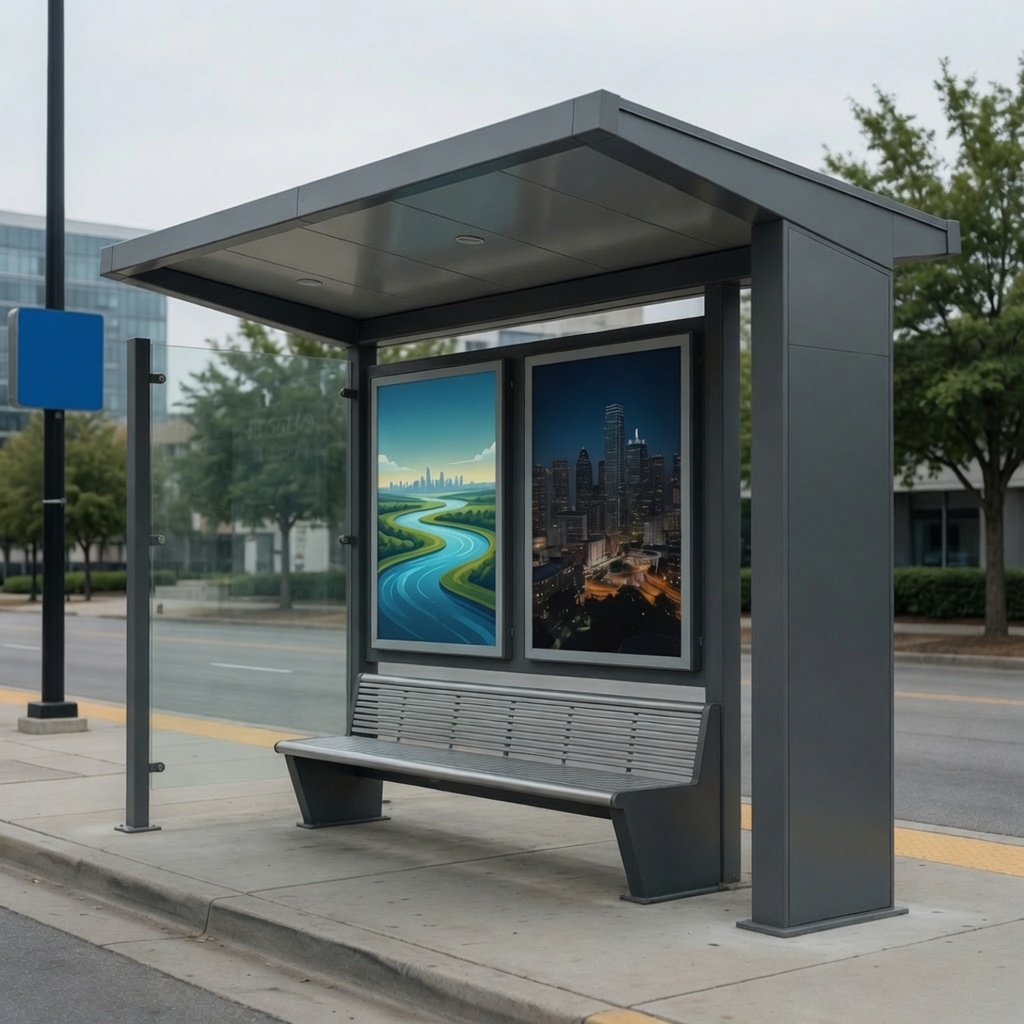
Transit and infrastructure fabrication is the structural and enclosure metalwork behind bus and rail shelters, EV-charging sites, smart-city furniture, and trackside equipment — the tube frames, panels, and weatherized cabinets that stand outdoors under public use for years at a time. Nevatronix Sheet Metal fabricates this hardware end to end for transit agencies, EV-charging integrators, and infrastructure OEMs — cutting, forming, welding, and finishing under one roof and one PO — and ships as a Buy America, US-made supplier nationwide.
What do we fabricate for transit and infrastructure programs?
Agency and OEM programs in this vertical draw on the same handful of structures and enclosures, at very different volumes. Across a program we fabricate:
- Bus and rail transit shelters, canopies, and platform railings. Structural frames, roof and canopy panels, and the railings that tie a platform together.
- Structural tube and post frames with glazing channels. Formed channel sections that hold shelter glazing on a weld-ready tube frame.
- EV-charging pedestals and weatherized NEMA-rated enclosures. Sealed-seam housings built to the electrical contractor’s or OEM’s print.
- Smart-city street furniture, info kiosks, and fare or validator housings. Formed and finished enclosures sized to the electronics they carry.
- Trackside and roadside equipment cabinets and grid or utility enclosures. Weatherized cabinets for signal, communications, and utility gear.
- ADA platform components and wayfinding or signage structures. Compliant platform hardware and the structural frames that carry signage.
What materials and welding procedures do transit structures need?
Structural tube and sheet in mild steel and aluminum cover most shelter and cabinet work — mild steel bends to 8 mm and aluminum to 10 mm on our press brakes — with stainless steel (304/316) reserved for the highest-corrosion trackside and coastal-adjacent applications. Our welders are qualified to AWS D1.1 (structural steel) and D1.2 (aluminum) procedures, WPS-controlled and documented, run through both robotic and manual welding depending on assembly geometry and volume.
How do you finish transit hardware for outdoor corrosion resistance?
Powder coat over zinc primer, applied in-house on a 24-hour turn with 40+ colors stocked, is the standard finish for shelters, cabinets, and street furniture that sit outdoors year-round; RAL and Pantone color matching lets a finish track an agency’s standard color palette. Where a corrosion spec calls for zinc coverage a powder finish can’t provide alone, hot-dip galvanizing runs through a managed partner, with the lead time folded into the quoted ship date.
What volumes and lead times can an agency rollout expect?
Programs run from a single prototype shelter to 50,000 units per release, with basic piece parts — brackets, panels, glazing channels — turning in 3 to 4 weeks and complex welded assemblies such as full shelter frames or cabinets in 10 to 12 weeks, with Kanban/JIT release for staged rollouts. That range is proven at agency scale: Nevatronix has built roughly 550 transit shelters for the RTC of Southern Nevada across two program runs, in 2022 and again in 2026, each pairing a powder-coated steel structure with an integrated high-brightness display housing.
Is this work Buy America compliant?
Yes. Every part is cut, formed, welded, and finished in our Las Vegas facility — nothing is fabricated offshore or through an intermediary shop — so parts can meet Buy America and domestic-content requirements common to federally funded (FTA/DOT) programs. Material certification and country-of-origin documentation ship with the program.
What documentation and traceability come with an agency program?
Every production order runs under our ISO 9001:2015 quality system, with first-article inspection and full lot traceability through a MIE Trak Pro ERP — documentation that stacks alongside the Buy America and country-of-origin paperwork a federally funded program already requires. Material certification follows the part where a structural or corrosion spec calls for it. For a multi-year rollout like a shelter program with releases years apart, that record is what lets a 2026 release match a 2022 one on material, finish, and dimension without re-qualifying the part from scratch.
Where does laser tube cutting fit, and what do we not do?
For the structural tube at the heart of a shelter or canopy, our co-located Nevatronix Laser fiber tube cell cuts copes, miters, and mounting holes in a single operation, so frames arrive at the weld cell ready to fixture. What we do not do: we build to the agency’s or OEM’s design rather than engineer shelter or enclosure systems ourselves, any MIL-STD-810 qualification testing stays with the customer’s accredited lab rather than us, and we do not install shelters, cabinets, or furniture on site — that scope belongs to the agency’s installing contractor.
Send a DXF or STEP with material, thickness, quantity, and finish, and we’ll quote your shelter, cabinet, or furniture program against real shop capacity — if a component suits a different process or shop better, we’ll tell you rather than force the fit. Request a quote.