
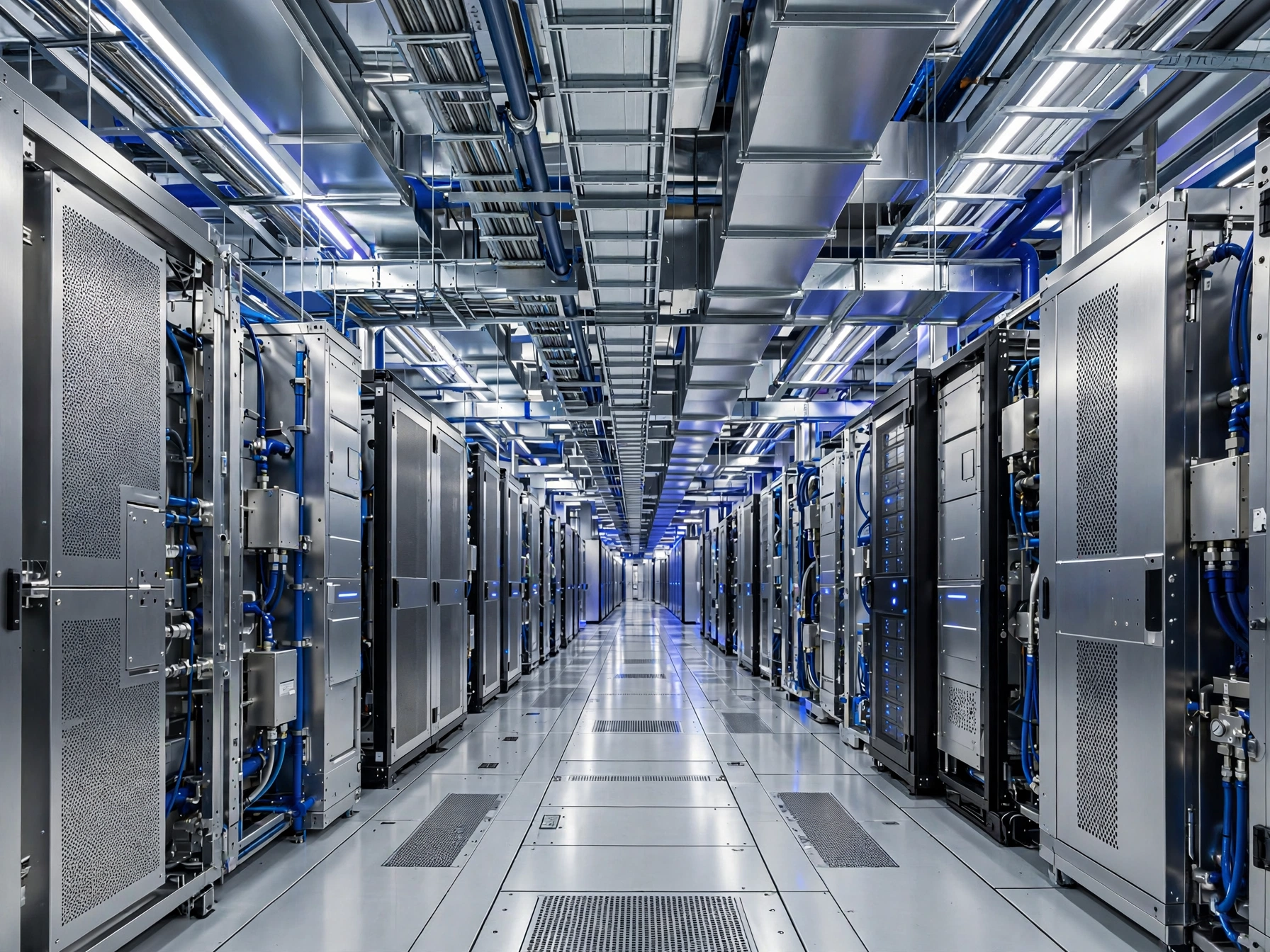
The Southwest is one of the fastest-growing data center regions in the country, and this shop is physically inside it — campuses across metro Las Vegas and Henderson, the Storey County cluster in northern Nevada, and the Phoenix build-out about four hours away by truck. Every one of those facilities consumes fabricated sheet metal from the day steel goes vertical to years after commissioning. Shell-and-core steel goes up first; then the fit-out trades move in — containment, cabling, power, and cooling — and the demand shifts from structural steel to precision fabrication: the panels, brackets, and enclosures that make a raised-floor hall actually work.
Where we fit on a data center program
We serve three kinds of buyers, and the boundary is the same for each: we fabricate components, and the people who engineer, install, and warranty systems own the rest. OEMs and system vendors — containment, cooling, rack, and enclosure makers — use us as overflow and second-source capacity, with revision control and first articles run the same way we run them for our kiosk customers. Electrical-contractor prefab programs buy enclosures, supports, and bracket runs at volume, on material-supply PO terms. Site and commissioning teams call us when Tuesday’s punch list needs a bracket by Friday — the advantage of a full fabrication floor twenty minutes from the corridor instead of two freight-weeks away.
What we fabricate on a data center build
A single facility pulls metal from several trades at once, on overlapping schedules. Across a program we fabricate:
- Hot- and cold-aisle containment. Panels, doors, ceiling frames, end-of-aisle assemblies, and fillers — formed and powder coated to print in data-center black.
- Cable-pathway and busway supports. Tray brackets, ladder-rack supports, threaded-rod trapezes, and busway hangers, run in the exact quantities a build needs.
- Rack and enclosure hardware. Blanking panels, adapter plates, PDU and cable-manager brackets, brush-grommet trim, and mounting rails.
- Aisle blanking and trim. The airflow-sealing metal that closes gaps in a row — snap-in blanking, filler plates, and trim strips.
- NEMA-rated electrical enclosures. Custom enclosures built to the customer’s print and NEMA construction spec, with hardware insertion, welding, and powder coat under one roof.
- Cooling-retrofit metal. CDU housings, manifold and header brackets, drip pans, and duct transitions for liquid- and air-cooling upgrades.
- Skid weldments and equipment stands. Frames, bases, and structural stands that carry gear on the floor.
White space vs gray space
The two halves of a data center consume different metal, and we fabricate for both. In the white space — the raised-floor IT halls — the demand is containment panels, blanking, cable-pathway supports, and rack trim — high-repeat parts where consistency across thousands of identical pieces is the whole game. Containment there is not decorative metal; it keeps cold supply air and hot return air from mixing, which is what protects the hall’s cooling efficiency, so the panels have to seal and align to the thermal design, not merely look right. In the gray space — the electrical and mechanical rooms carrying the IT load — it shifts to heavier NEMA-rated enclosures, switchgear and transformer barriers, busway supports, and cooling-plant metal. A build needs both at once, which is exactly the mix a full press brake, punch, and welding floor is built to carry.
Built for speed and repeatability
Data center schedules are unforgiving, and the metal has to arrive install-ready and identical, part after part. Four capabilities carry that:
- Kitting staged to the install sequence. Parts arrive bagged, labeled, and ordered to how the crew installs them — not dumped as a pile to sort on site.
- Hardware insertion. Self-clinching PEM nuts, studs, and standoffs installed in-house through our assembly cell, so panels land ready to bolt up — see the PEM hardware hole size chart.
- Robotic welds for repeatable assemblies. Robotic welding holds weld placement and appearance identical across a production run of frames and enclosures.
- First article and revision control. Every production order gets a first-article inspection and full lot traceability through a MIE Trak Pro ERP, at volumes from 1 to 50,000 units.
Nevada logistics for the Southwest corridors
Being in the Las Vegas valley puts this shop inside the region’s build-out rather than a freight lane away from it. The southern Nevada campuses across metro Las Vegas and Henderson are local delivery; the northern Nevada cluster around Storey County and the Reno-Sparks corridor is a scheduled truck; and the Phoenix build-out is roughly four hours by road. For planned production that means predictable ship dates into the corridor with no cross-country freight; for urgent site parts — a bracket, an adapter plate, an enclosure modification during commissioning — it means delivery in days rather than freight-weeks, scheduled honestly against live shop loading.
Documentation and traceability on the program
Data center programs — especially the ones feeding hyperscale and colocation build-outs — buy on documentation as much as on parts. Every production order runs under our ISO 9001:2015 quality system with a first-article inspection report, lot traceability, and revision control through a MIE Trak Pro ERP. Material certifications follow the part where the spec calls for them, and the serialized traceability that has been standard on our gaming and fintech programs for two decades transfers directly to enclosures and containment a facility has to track in its asset system. When a revision lands mid-program — and on a fast build it will — the change is controlled, the affected lot is identified, and the first article on the new revision runs before volume resumes. That discipline is why an OEM can hand us overflow without re-qualifying the part every time.
Materials and finishes for the data hall
The metal follows the location. Containment and rack trim on display in the aisle is cold-rolled or pre-galvanized steel powder coated in data-center black — RAL 9005 stocked — for a uniform, low-glare finish. Structural and gray-space supports run in heavier gauge, hot-dip galvanized through a managed partner where corrosion exposure demands it. Enclosures carrying a NEMA construction spec get sealed seams and gasketing to the type on the print. Powder coat is in-house on a 24-hour turn, so a containment release does not wait on an outside coater, and cut edges and welds on galvanized stock are masked, primed, and coated to restore the corrosion barrier fabrication opens up.
Security cages, partitions, and the long tail
Beyond containment and enclosures, a build consumes a long tail of fabricated metal: security cages and partitions that segregate customer cages in a colocation hall, equipment stands and skid weldments that carry gear on the floor, and the adapter plates, blanking panels, and one-off brackets a commissioning punch list generates by the dozen. We fabricate all of it to print on the same floor. That is the practical advantage of a full-stack shop over a single-process specialist — one supplier across containment, enclosures, supports, cages, and the urgent bracket, instead of a different vendor and a different lead time for each.
One shop for the whole build
The reason to consolidate a data center metal package here is simple: containment, enclosures, supports, security cages, and fast-turn site parts all come off one floor, under one ISO 9001:2015 quality system and one MIE Trak Pro traceability record, co-located with Nevatronix Laser for cutting under the same roof. One supplier, one PO, one ship date — send a print and judge the first article, then request a quote.