
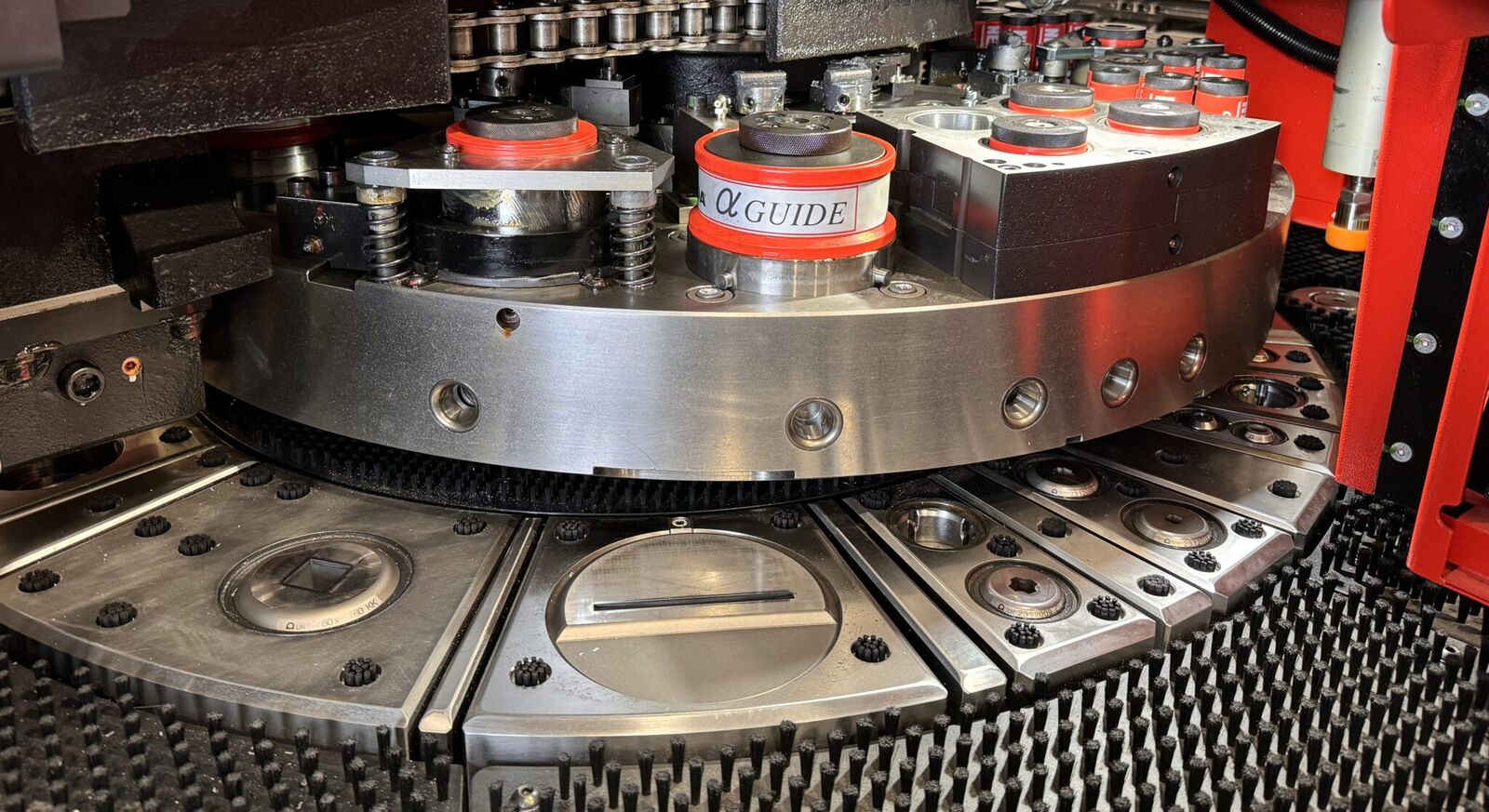
CNC metal punching is a sheet metal process that presses tooling through flat sheet to produce holes, cutouts, and — critically — formed features, using a CNC-controlled turret that indexes the right tool over each location. Where a laser traces every feature with a single beam, a punch press has a magazine of dedicated tools and simply hammers each feature into place. That difference is the whole story: punching is the fastest, cheapest way to make repeated features and the only way to make formed features on a flat-sheet machine.
Nevatronix Sheet Metal runs a 32-station CNC turret punch alongside our laser and forming cells. It exists to do the work a laser does slowly or cannot do at all — hundreds of identical holes, ventilation louvers, dimpled embosses, countersinks, and tapped extrusions — on production panels for electrical, data center, HVAC, and gaming enclosures.
What CNC turret punching does best
Punching earns its place on a part through features that are either repeated or formed:
- High-volume hole patterns. Perforated panels, vent fields, and mounting-hole grids — a turret press indexes and strikes each hole in a fraction of a second, so cost per hole falls as the count climbs.
- Louvers and gills. The tool lances and forms the sheet in one hit, producing airflow openings that a flat cut simply cannot make.
- Countersinks. A formed cone that seats flat-head hardware flush with the panel face, punched in the same setup as the hole.
- Embosses and stiffening ribs. Raised or dimpled forms that add rigidity, create standoffs, or carry a brand mark — no secondary operation.
- Tapped extrusions. A drawn collar pulled out of the sheet that gives thin material enough depth to hold a real thread.
If a feature is defined by being made many times or by being pushed out of the plane of the sheet, it belongs on the punch. If it is defined by a unique outline, it belongs on the laser.
Punching vs laser: which is cheaper for your part
This is the question that actually drives the quote, and the honest answer is that it depends on what the part is made of geometrically — not on which machine is “better.” Here is the trade-off laid out plainly.
| Part characteristic | CNC turret punching | Laser cutting |
|---|---|---|
| Formed features (louvers, countersinks, embosses, extrusions) | Formed in the same setup | Not possible — flat cut only |
| High-volume repeated holes | Fastest, lowest cost per feature | Slower, higher cost per hole |
| Complex or tight-radius profiles | Limited to tool shapes (nibbled) | Best — any profile, clean edge |
| Low volume / one-off | Tooling setup adds cost | Best — no tooling to set |
| Edge quality and tolerance | Good; slight die witness | Best; clean cut edge |
The pattern to internalize: laser wins on low volume and complex profiles; punching wins on formed features and repeated features at volume. A one-off bracket with an organic outline is a laser part. A thousand enclosure side panels with a louver field, a countersunk hardware pattern, and forty identical mounting holes is a punch part. And a great many real parts are both — which is why the cheapest route is usually to laser the perimeter and complex cutouts, then punch the standard pattern and formed features. Because both cells are on the same floor and share the 1500 × 3000 mm sheet envelope, that split costs no inter-cell freight and produces one quality record. If your part could go either way for the same function, the laser-cut-versus-formed breakdown on our sister site works through the process-selection logic in more depth.
The documented capacity envelope
Our CNC turret punch works within a defined envelope. Use these numbers to sanity-check a design before you send it:
- Sheet size up to 1500 × 3000 mm — matched to the laser cell so parts move between the two without re-fixturing.
- Thickness up to 6 mm in mild steel and aluminum, 5 mm in stainless. Heavier plate is sheared or laser-cut upstream.
- Hole position to ±0.1 mm, with a minimum punched hole of 1.5 mm diameter.
- 32 tool stations live in the turret at once, so multi-feature panels run without a tooling change mid-job.
Punch press tonnage governs the heaviest single hit a tool can make; we size the tool and hit to the material and feature rather than publishing a headline number, so send the part and we will confirm the feature is within the press capacity on the quote. The capability snapshot in the sidebar carries the full spec list.
Every punched feature holds ±0.1 mm position. On a production run we confirm the first article, lock the program, and sample-inspect through the run under the same ISO 9001:2015 quality system as the rest of the shop. Nesting is optimized at first article, which matters because on a punch-heavy part the material is usually the single largest cost — a dense hole-pattern job wins on parts-per-sheet yield as much as on cycle time, so we lay the nest to get the most panels out of every sheet before the run locks.
Material-by-material notes
- Mild steel (up to 6 mm). The workhorse — clean punching, predictable tool life, and the material most louver, perforation, and hardware-pattern work is done in.
- Stainless steel (up to 5 mm). Tougher and more abrasive, so we run it at a reduced maximum thickness and manage tool wear accordingly. Excellent for corrosion-exposed vent and grille panels.
- Aluminum (up to 6 mm). Soft and fast to punch; ideal for lightweight perforated panels and heat-dissipating vent fields. Watch minimum web width between closely spaced holes.
- Galvanized and pre-painted stock. Punched with tooling and handling that protect the coating so the cosmetic face reaches finishing intact.
The tooling library
The turret holds 32 stations, which means a single program can carry the round, obround, square, and rectangular tools that cut holes and slots plus the special forming tools — louver, countersink, emboss, extrude, and lance-and-form — in the same setup. A dense, multi-feature panel therefore runs start to finish without an operator swapping tools mid-job, which is a large part of why punching is fast on production work. When a feature needs a shape we do not stock, a dedicated tool is sourced and amortized over the run; for tapped extrusions, the extrusion tool and the tap are matched so the drawn collar carries a full thread — see the tap drill chart for the thin-sheet thread logic and the gauge chart for stock thickness.
Applications by vertical
Punch work concentrates wherever panels need airflow, dense hardware patterns, or formed features at volume. In electrical and data center enclosures, that is ventilation louvers, fan grilles, and countersunk mounting patterns. In HVAC, it is perforated returns and filter grilles. In gaming and smart-automation cabinets, it is speaker grilles, brand embosses, and the repeated hardware patterns that hold a build together. Across all of them, punched parts flow directly into press brake forming for bends, finishing and coating for powder coat, and assembly for hardware insertion and packout — one shop, one PO, one ship date.
How we’d quote your part
Send a STEP or DXF with material, thickness, and the feature callouts — louver free-area percentage, countersink angle, extrusion thread size, hole pattern. We will confirm what runs on the punch, what belongs on the laser, and where combining the two saves money, then quote it against real process capability. Start at our quote page; most parts turn a quote within a business day.