
Process Selection
Press brake vs roll forming
A press brake shop's honest comparison for procurement engineers — geometry, length, tolerance, setup time, and the quantities where roll forming starts to win.
By Nevatronix Sheet Metal 7 min read
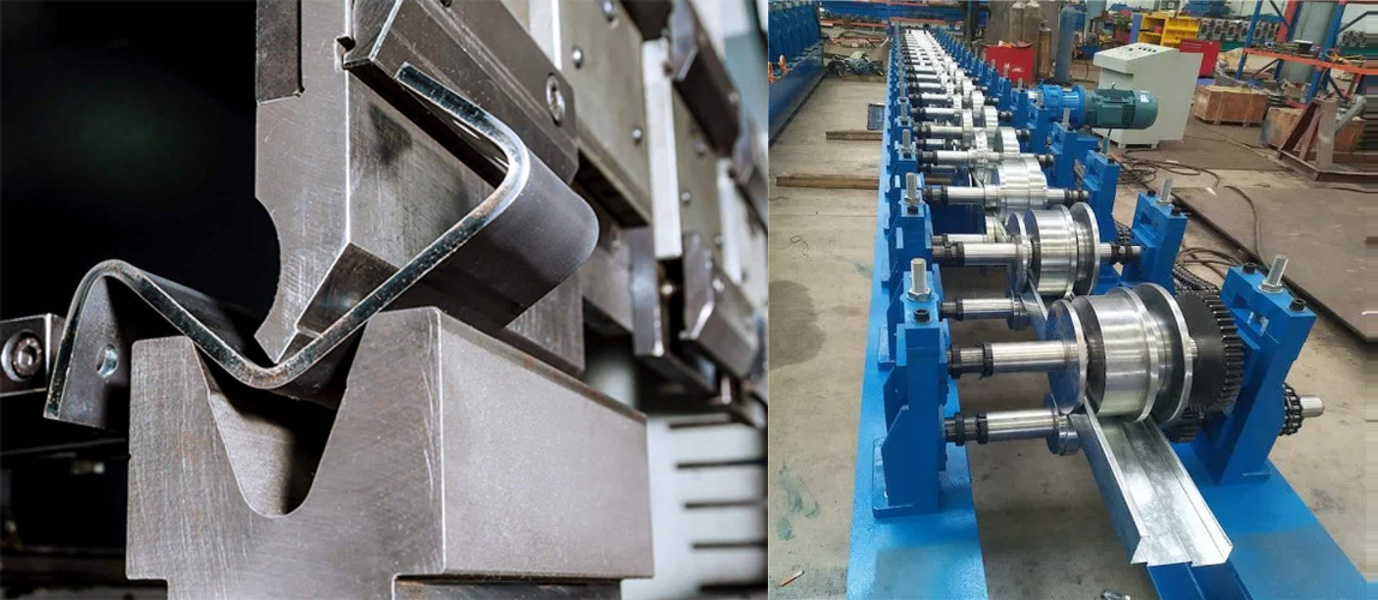
The short answer: press brake forming wins for almost every procurement part you’re scoping today — short and medium parts, complex multi-bend geometry, batches under about 1,000 linear meters of a single profile. Roll forming wins above that crossover, where its continuous cycle time and low per-part labor pay back the tooling investment. The rest of this page is the detail behind the one-sentence answer.
What’s the actual difference?
Press brake forming is a discrete process: a V-die and matching punch press a section of flat sheet into a bend, one bend at a time. Tonnage from a hydraulic or servo-electric ram drives the punch into the die at a controlled depth, setting the bend angle and inside radius. Multi-bend parts are formed in sequence — operator or robotic handler positions the sheet between strokes.
Roll forming is continuous: flat strip stock is fed through a series of progressive roll stands, each one applying an incremental forming change. By the time the strip exits the last stand, it has the finished profile. The line runs at a steady linear speed (typically 30–150 m/min) until the coil is exhausted or the cut-off shears a part to length.
Same end goal — turn flat sheet into a formed profile — but the economics, geometric flexibility, and length constraints couldn’t be more different.
Geometry: what each process can make
| Geometric requirement | Press brake | Roll forming |
|---|---|---|
| Single straight bend | Yes — bread and butter | Yes |
| Multi-bend profile (channel, hat, Z) | Yes — sequential bends | Yes — if it’s a single fixed profile |
| Variable cross-section along length | Yes — different bends per zone | No — profile is fixed by the roll set |
| Curved or radiused bends | Limited (requires special tooling) | Yes — defined by roll geometry |
| Holes, slots, embossments | Add before or after forming | Punching can be integrated inline |
| Cut to specific length | Cut before or after | Inline shear at line speed |
| Complex 3D parts with multiple feature directions | Yes — bend in multiple orientations | No — profile is constant along length |
Press brake’s flexibility is its defining feature: any profile within the tonnage envelope, any part shorter than the bed, any quantity from one to many thousands. Roll forming’s rigidity is also its defining feature: one profile per roll set, continuous lengths, very high throughput on the parts that match the tooling.
Maximum length and material capacity
| Capability | Press brake (typical) | Roll forming (typical) |
|---|---|---|
| Maximum length per part | 3–4 m on most production brakes; up to 6 m on specialty | Effectively unlimited (coil-fed continuous process) |
| Tonnage range | 50–500 tons across the industry | N/A (each stand contributes incremental force) |
| Material thickness | 0.5–16 mm depending on brake tonnage and bend length | Typically 0.4–6 mm for any given roll set |
| Material grades | Most ductile sheet — mild, stainless, aluminum, coated, pre-painted | Same materials; tighter thickness windows per roll set |
| Setup change between profiles | 30 seconds to 5 minutes per station | 2 to 8 hours per roll set |
The length ceiling is the single most common reason a part can’t be press-brake formed. If the design calls for a continuous 8 m channel section, no production brake will handle it in one piece — you’re either splicing two welded sections or specifying roll forming.
Tolerance and bend radius control
Both processes can hit production-grade tolerances, but the failure modes are different.
Press brake angular tolerance runs ±0.5° on most production work, tightened to ±0.25° on equipment with adaptive crowning and angle measurement. Bend angle is sensitive to material spring-back, which varies with sheet thickness and material lot. Modern brakes compensate by overbending and measuring; older equipment relies on operator skill.
Press brake inside bend radius on air bending is typically 1× material thickness for mild steel and 1–2× for harder grades. Bottom bending or coining tightens this to about 0.5× thickness at the cost of higher tonnage and faster tool wear. Tighter radii are possible with specialty tooling but at proportionally higher per-part cost. Per-material minimums are on the minimum bend radius chart.
Roll forming tolerances are determined by the roll set, not the operator. Once the line is set up correctly, every part exits the same — angular variation is typically ±0.5° on commercial profiles, often tighter on automotive or architectural production where the tooling is built for precision. Inside radius is fixed by the roll geometry; changing radius requires changing rolls.
The trade-off in plain language: press brake tolerances are flexible but operator-dependent; roll forming tolerances are rigid but operator-independent. For batches that vary part-to-part, press brake is more forgiving. For high-volume identical profiles, roll forming produces tighter dimensional consistency.
Setup time vs cycle time
This is the trade-off most procurement decisions hinge on.
Press brake setup is fast: a CNC brake with quick-change tooling can swap punches and dies in 30 seconds to 5 minutes per station, programming a multi-bend sequence in 5–30 minutes from a CAD file. First good part is typically 30–60 minutes from quote acceptance.
Roll forming setup is slow: roll change is 2–8 hours of skilled labor for a standard profile, longer for complex multi-stand setups. Once the line is running, though, throughput is measured in meters per minute, not seconds per part.
Cross over the math:
- A 4 m channel section on a press brake might take 20–40 seconds of cycle time per part, plus operator handling.
- The same profile on a roll forming line cycles at 30–150 m/min — call it 60 m/min average — so 4 m of part comes off the line every 4 seconds.
At low quantities (fewer than 100 parts), press brake’s near-zero setup wins easily. At high quantities (more than 5,000 linear meters), roll forming’s continuous cycle wins easily. The interesting zone is in between — typically 100 to 5,000 linear meters — where the math depends on profile complexity, roll set availability, and shop rates on each process.
Tooling and capital cost
Press brake tooling is modular and reusable: standard punches and dies range from $200–$2,000 per station and serve hundreds of different part geometries. Most production shops have a tooling library worth $50K–$200K accumulated over years, and any new part typically uses existing tooling without additional cost.
Roll forming tooling is dedicated and expensive: a roll set for a specific profile costs $20,000–$200,000+, sometimes higher for complex profiles with many forming stations or specialty materials. That tooling is locked to one profile — making a different profile means buying a different roll set.
Capital cost is more comparable: a 200-ton CNC press brake runs $200K–$500K new; a production roll forming line in a comparable size class runs $300K–$1M+ depending on number of stands and capability. Most contract manufacturers run multiple press brakes for parallel throughput and don’t operate roll forming in-house — it’s specialty equipment serving specialty volumes.
The procurement implication: if your part needs custom tooling that doesn’t already exist in either process, press brake almost always wins because the tooling cost is a fraction of roll forming. If your part can use existing roll tooling at a roll forming vendor, that calculation flips at high volumes.
When roll forming wins
Three cases where roll forming is the right answer:
- Very long parts. Anything longer than press brake bed length — gutters, fascia, curtain wall mullions, automotive trim, solar racking rails. If the part needs to be continuous past 4 m, roll forming or extrusion are usually the only options.
- Very high volume of a single fixed profile. Once you’re committing to 5,000+ linear meters of one profile with no design changes, roll forming’s per-part labor and consistency win. Standard industrial profiles (C-channel, Z-purlin, hat sections) are the canonical examples.
- Inline integration. If the production requires cut-to-length, hole punching, and forming in a single pass, an integrated roll forming line can do all three at line speed. Press brake operations require separate cutting and punching steps before forming.
When press brake wins (most procurement parts)
For sheet metal parts under 4 m in length, with mixed-complexity geometry or quantities below roughly 5,000 linear meters of a single profile, press brake wins on:
- Setup speed — minutes to first good part, not hours.
- Tooling cost — standard tooling, no dedicated investment.
- Geometric flexibility — multi-bend sequences, varied profiles within a single batch, design changes between revisions.
- Mixed-material handling — same brake forms mild, stainless, aluminum, coated, and pre-painted without retooling.
- Lower-volume economics — break-even at production runs of 1 to ~5,000 linear meters.
- Quote turnaround — quotes return within a business day from a CAD file; no tooling design phase.
If your part lives in any of those buckets — and most procurement parts do — press brake is almost certainly the right tool.
How we’d quote your part
Send a STEP or DXF file with material grade, thickness, and quantity ranges to our quote page. One business day turnaround on most jobs. If the part needs continuous length past 4 m or volumes above the press brake crossover, we’ll say so and recommend a roll forming partner — that’s the point of writing for procurement engineers.
References
- AISI S100 — North American Specification for the Design of Cold-Formed Steel Structural Members
- ASTM A1011 — Standard specification for steel sheet, carbon, structural, and high-strength low-alloy, hot-rolled
- ANSI B11.3 — Safety requirements for power press brakes
- Fabricators & Manufacturers Association International — sheet metal forming resources
- ISO 6892-1 — Metallic materials: tensile testing at room temperature (basis for formability specs)
Frequently asked questions
- When should I use a press brake instead of roll forming?
- For parts shorter than the brake length (typically 3–4 m on most shops), parts with multiple bends or complex geometry, or production runs under roughly 1,000 linear meters of a single profile. Press brake setup is minutes; roll forming setup is hours. Below the crossover quantity, press brake wins on total cost. Above it, roll forming wins.
- Can a press brake make long parts?
- Up to the brake's bed length — typically 3–4 m on most production sheet metal shops, sometimes 6 m on specialty equipment. Parts longer than the bed have to be either spliced from shorter sections (with a weld joint) or run on roll forming or a tandem-press setup. Most procurement parts fit inside a 4 m envelope.
- What's the minimum quantity to justify roll forming?
- Roll forming tooling typically costs $20,000 to $200,000+ depending on profile complexity, plus setup time measured in hours. The break-even quantity vs press brake is usually 1,000 to 10,000 linear meters of a single, fixed profile. Below that, the tooling amortization makes roll forming more expensive per part. Above it, the continuous cycle time wins.
- How long are typical roll forming setup times?
- Roll change on a roll forming line is typically 2–8 hours of skilled labor, sometimes longer for complex multi-stand profiles. Press brake tool change is 30 seconds to 5 minutes per station with quick-change tooling. That setup gap is why roll forming only economically beats press brake on high-volume, single-profile runs.
- What bend radius can a press brake hold?
- Air bending typically holds the inside bend radius to 1× material thickness for mild steel, 1–2× for harder grades. Bottom bending or coining can go tighter — down to 0.5× thickness — at higher tonnage and tool wear. Bend angle tolerance is typically ±0.5°, tighter with adaptive crowning control.
- Is roll forming cheaper than press brake forming?
- Only at scale. On a per-part basis at high volume (10,000+ linear meters of one profile), roll forming has a lower unit cost because the cycle time is continuous and a single operator runs the line. At low and medium volumes, the tooling amortization and setup time make roll forming more expensive overall.
- What materials can be roll formed?
- Most ductile sheet metals: mild steel, stainless, aluminum, brass, copper, galvanized steel, and pre-painted coil. Material gauge ranges are tighter than press brake — once a roll set is built for a specific thickness range, going outside that range requires new rolls. Press brake is more forgiving on thickness variation within its tonnage envelope.